In sports betting, understanding the markets is essential. They are the ‘what’ you bet on, and not all of them work the same way. Each market has its own logic, associated risk and ideal time to use it. Below, we review the most relevant ones:
– 1X2 (Final result): bet on a home win (1), a draw (X) or an away win (2).
– Double chance: you cover two of the three possible outcomes (1X, 12, X2). Lower odds, but less risk.
– Draw no bet (DNB): if there is a draw, you get your money back. Very useful in evenly matched games.
– Over/Under (Totals): more or less than X goals, points or games. Ideal for sports with reliable historical data.
– Both teams to score (BTTS): yes or no. Widely used in football.
– European handicap: an integer number of goals is added or subtracted from one of the teams. There can be a draw.
– Asian handicap: more flexible. Eliminates the draw as an option and allows the bet to be split (e.g. -0.25).
– Exact score: you bet on a literal result. High risk, high reward.
– Half-time/full-time: you predict how the match will be at half-time and how it will end.
– Futures (outrights): league champion, top scorer, etc.
– Props (specials): number of corners, cards, shots, etc.
These markets are not just chosen on intuition: they are selected based on analysis and the risk you are willing to take.
The key is to combine analysis and bankroll management. For example, if you expect a close match with few goals, an under 2.5 may be more reasonable than an exact score. Or if there is a clear favourite, a -1 or -1.5 handicap can improve the odds without increasing the risk too much.
Let’s look at two common scenarios:
– Over/Under is easier to model if you work with statistics such as expected goals (xG), pace of play or head-to-head matchups.
– The exact score, on the other hand, has a lot of variance. It is not a market to use frequently, nor for high stakes.
– The European handicap allows for a draw, but its resolution is simpler.
– The Asian handicap divides risks and allows you to recover part of your stake if the result is ‘halfway’. It is more technical, but also more profitable if you understand it well.
Combined bets multiply the odds… and also the risk. They are popular, yes, but difficult to make profitable. If just one selection fails, you lose the entire bet.
Systems (such as Trixie or Yankee) allow you to combine bets without everything depending on a single failure. You sacrifice high odds in exchange for greater control over variance.
If you are just starting out or working with a model that you are still validating, systems give you more stability.
Live betting allows you to find value if you know how to read the game: a team dominating without scoring, an early card that changes the approach, a key injury… But it is also the favourite terrain for emotional mistakes.
That’s why many bettors already use tools to automate live decisions and avoid impulsive bets. Having clear, predefined rules is more effective than improvising.
A value bet is a bet with statistical value. It occurs when your probability estimate is higher than that reflected in the bookmaker’s odds.
Example: you believe that a team has a 60% chance of winning, but the odds are 2.20 (£2.20) (equivalent to 45%). That difference, if consistent, is profitable in the long run.
However, finding value bets is not easy. It requires models, data, patience… and this is where automation comes in.
Sports betting software allows you to standardise decisions. It detects mispriced markets, applies your rules and executes bets according to your own criteria.
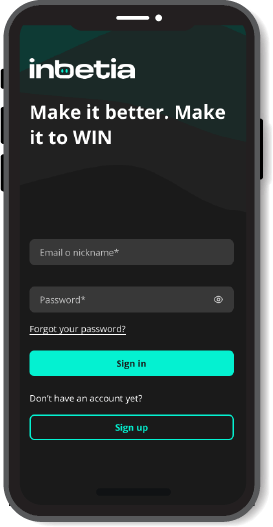
With an automated sports betting app like Inbetia, you can:
– Configure your strategy (minimum odds, stake, market type).
– Connect to compatible bookmakers.
– Detect value bet opportunities.
– Execute automatically with bots.
– Monitor results and key metrics (ROI, yield, drawdown).
In addition, by automating, you reduce human error and always apply your method, even when you are not in front of the screen.
A betting bot does not make decisions for you. It applies what you define: which markets to trade, with what stake, under what conditions. It is a tool, not a magic wand.
When properly configured, a bot provides discipline, speed and scalability. The key is in the design of the strategy beforehand.
Before we finish, here are some best practices that remain unchanged even if you automate:
– Define a bankroll and use a fixed stake (between 0.5% and 1.5%).
– Avoid chasing losses or entering without analysis.
– Record everything: what bets you make, in which markets, with what results.
– Do not trade markets you do not understand well.
– Set limits. Betting with rules is not only profitable: it is also healthier.
If you already know what type of bets work for you, the next step is to systematise the process.
Do this with a tool that connects your strategy with automatic execution.